
Condominiums first appeared in the world, specifically in Europe in the 18th century, while in Vietnam they only emerged in the 20th century. The history of condominium development is still very young compared to the thousands of years of feng shui history. Therefore, not many feng shui texts mention this property type, which is why there are still many misconceptions about apartment feng shui.
Currently, there are two schools of thought debating how to determine the direction of an apartment unit, and no consensus has been reached:
The apartment’s direction is the main door direction
In feng shui, there is a saying “Khai mon lap huong” (Open the door to establish direction), meaning that to establish the direction, one must rely on the main door. Where people go, qi follows — the essence of the main door direction is that it is where the house receives qi. This qi is created by the movement and interaction of people with the house, not by natural factors like wind or sunlight. A house can only be lived in and used when it has a main door; people maintain their daily life activities by passing through the door.
From landed houses to condominiums, many people still strictly follow the principle: to determine an apartment’s feng shui direction, one must rely on the main door direction, while the balcony direction cannot determine whether that apartment is good for the homeowner or not. Think simply — if an apartment has no access to the balcony, the apartment still functions, but if the apartment door is broken and cannot be entered, then even if the apartment has a balcony, it would be abandoned, because there is no way to enter the apartment from the balcony.
But when determining the main door direction, should we look at the main door of the condominium building or the main door of the apartment unit? Most feng shui masters rely on the apartment unit’s main door direction while forgetting that the first place receiving qi is the condominium building’s entrance — the main door at the ground floor lobby, or the entrance to the parking basement (if applicable). To understand easily, think of the condominium building as a multi-story house, and the apartment unit as a room in that house. Therefore, when establishing the direction, one must rely on the condominium building’s main door, just like establishing the direction of a house, rather than relying on the room’s door to establish the direction.
The building’s main door direction is used to divide sectors and establish the Flying Star chart. The condominium building’s main door direction must be auspicious first, then the apartment unit’s entrance direction is considered. If both directions bring in good qi, that is excellent. However, if the apartment entrance direction is good but the building entrance direction is inauspicious, the result is only average. Additionally, one must also examine the influence of qi from the staircase and corridor leading to the apartment unit to truly understand what is auspicious or inauspicious.
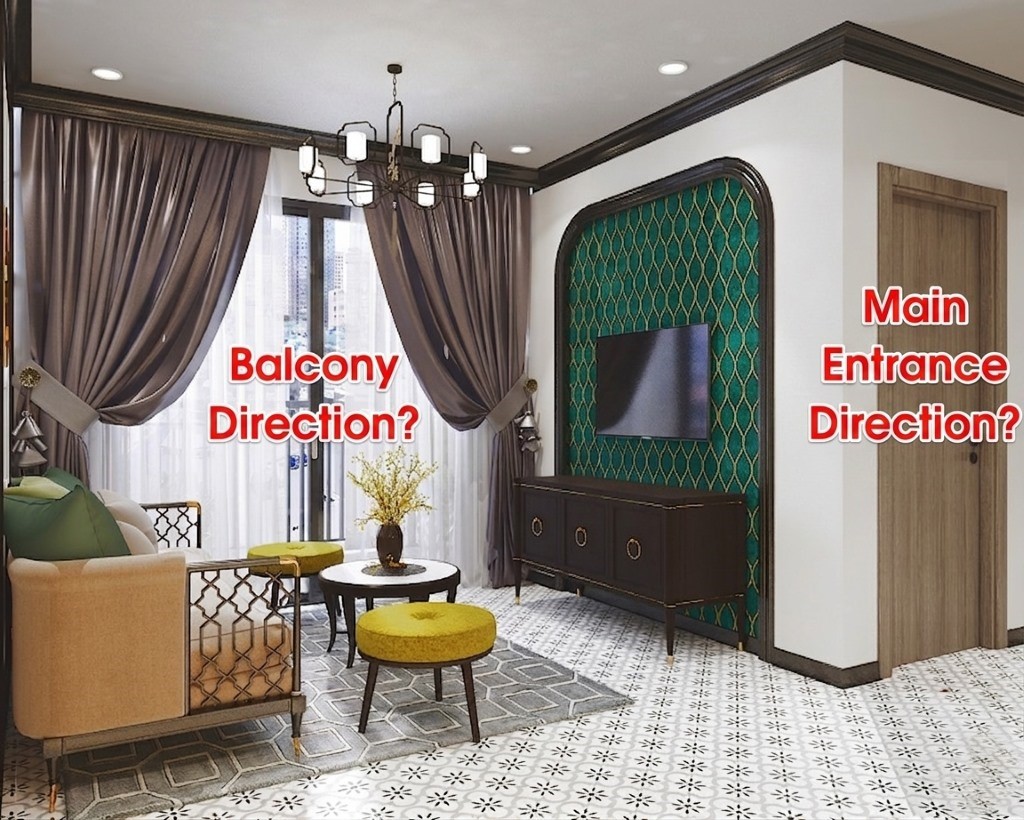
The apartment’s direction is the balcony direction
In reality, the apartment door is usually kept closed for privacy, while the balcony is actually the place that receives the most heavenly qi (thien khi) and earth qi (dia khi). Practice shows that the best place for receiving qi in an apartment is the balcony — this is where the most natural wind and sunlight are received, where interaction with the outside environment occurs, and where qi is channeled and circulated. That is why in condominiums, the living room is usually placed near the balcony, because this area always has a good magnetic field, an open and spacious view, and provides the most comfort. From the above analysis, many people believe that: determining an apartment’s feng shui direction should be based on the balcony direction, not the apartment unit’s door direction.
The mistake of focusing too much on the main door or balcony direction
Both viewpoints — determining the apartment direction based on the door or the balcony — have their own valid reasoning. When it comes to determining direction, one should combine both viewpoints to achieve the best results.
However, we should not worry if one of these two factors is inauspicious, or even if both are inauspicious, because apartment feng shui involves many other factors to consider, such as: the surrounding landscape, the feng shui layout of the condominium building, the position of the apartment unit, the interior arrangement, the way the apartment is decorated, and more. At the same time, direction only accounts for 20% of the influence in feng shui, while position accounts for up to 80%. There is a feng shui saying: “First position, second direction” (nhat vi, nhi huong) — and that is exactly why.
Therefore, let us change our thinking about apartment feng shui. Do not use only the main door direction or balcony direction as the sole criterion for choosing an apartment. Consider it only as a necessary condition, and combine it with many other criteria to satisfy the sufficient condition for a living space with proper feng shui.
* Information is for reference purposes only